
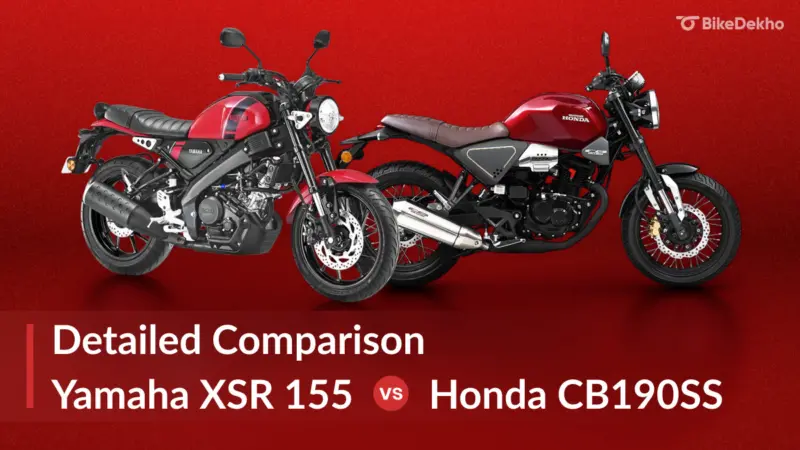

Yes, there's an equally gorgeous retro rival from Honda, and here's how it stacks up against the XSR!
The Yamaha XSR 155 is one of the latest neo-retro motorcycles in India, and has no direct competition in the market so far.
However, another Japanese automaker sells a bike in our neighbouring country that can be its potential rival. The Honda CB190SS, sold in China, may not be able to outperform Yamaha's contender, but its appearance alone is capable enough to pull a fair share of the XSR buyers. So, let's dive into a detailed comparison and find out how they both will compete with each other:
Price & Variants
Yamaha XSR155 | Honda CB190SS | ||
Variant | Ex-showroom Price | Variant | Expected Ex-showroom Price (India) |
Metallic Blue | Rs 1,49,990 | Standard | Rs 1.40 lakh |
Vivid Red | Rs 1,52,990 | ||
Metallic Grey | Rs 1,56,990 | ||
Greyish Green Metallic | Rs 1,58,990 | ||
Metallic Black | Rs 1,58,990 |
While the Honda CB190SS is not available in India, in China, it comes in a single trim option. Sure, it will not be launched in India, but for the sake of comparison, if we were to guesstimate its price here, then it could cost Rs 1.40 lakh. Yes, that would be expensive for an air-cooled bike, but we reckon Honda would want to keep things premium for such a gorgeous-looking motorcycle.
The XSR 155 also comes in a single variant that fairly justifies its price tag with premium features, hardware, and performance. It also offers the option to uplift aesthetics with optional Cafe Racer or Scrambler kits.
Design and Dimension
Specification | Yamaha XSR155 | Honda CB190SS | Difference |
Wheelbase | 1,330 mm | 1,360 mm | -30 mm |
Ground Clearance | 170 mm | 170 mm | 0mm- |
Kerb Weight | 137 kg | 145 kg | -8 kg |
Seat Height | 810 mm | 785 mm | +25 mm |
Fuel Tank Capacity | 10 litres | 15.3 litres | -5.3 litres |
The slightly longer and heavier CB190SS also has a longer wheelbase, which should provide it with better straight-line stability at high speeds.
Meanwhile, the Yamaha XSR 155 is compact and lighter, offering sharper handling and better flickability in traffic.
While both have similar ground clearance, the lower seat height makes the Honda more approachable for shorter riders than the XSR 155.
A larger fuel tank also gives the CB190SS an advantage in touring range over the XSR.
Both motorcycles perfectly blend neo and retro elements in their design language. It's just that the XSR 155 leans a bit more towards a modern touch, while the CB190SS offers a slightly better classic feel.
There are many design similarities such as the round headlamp, sculpted fuel tanks, and other visual elements between the two.
However, the perimeter frame, alloy wheels, and stubby black muffler make the XSR look sportier. The CB190SS, meanwhile, also keeps the classic charm alive in stainless-steel and brushed-metal details, wire-spoke wheels, and a long, shiny tailpipe.
Ride & Handling
Specification | Yamaha XSR155 | Honda CB190SS |
Frame Type | Deltabox (Perimeter-type) | Diamond Frame |
Front Suspension | Inverted Fork | |
Rear Suspension | Link-type Monoshock | Monoshock |
Front Brake | 282mm Disc | 276mm Disc |
Rear Brake | 220mm Disc | 220mm Disc |
Front Tyre | 110/70 - 17 (Tubeless) | 110/70 - 17 (Tubed) |
Rear Tyre | 140/70 - 17 (Tubeless) | 140/70 - 17 (Tubed) |
Wheels | 17-inch Alloy | 17-inch Wire-Spoke |
Benefitting from the racing-derived Deltabox frame and a cast-aluminium swing arm, the Yamaha offers a higher level of rigidity and sharper handling characteristics. On the other hand, the Diamond frame of the CB190SS focuses on stability, simplicity, and comfort.
Both come equipped with an inverted and monoshock. However, theXSR's suspension is tuned to be on the firmer side to add to its sharper handling and cornering stability. Meanwhile, the CB190SS offers a more luxurious experience, better suited to open highways and relaxed city riding conditions.
Wheel and tyre sizes are also similar on the two, but their types make a huge difference. The XSR 155 feels solid on the tarmac, thanks to its alloy wheels, and its tubeless tyres offer better puncture resistance. The flex of wire-spoke wheels, on the other hand, makes the CB190SS a more comfortable option, especially on broken roads. Repairing its tubed tyres for a puncture is a big task, though.
The braking setup is similar as well, except the Honda features petal discs. Still, the XSR 155 has the upper hand here, offering dual-channel ABS, while the CB190SS has only ABS at the front (single-channel).
Features & Tech
Features | Yamaha XSR155 | Honda CB190SS |
Lighting | All-LED | All-LED |
Instrument Cluster | Digital LCD | Digi-Analogue |
Connectivity | Y-Connect (Bluetooth) | Not Available |
ABS | Dual-Channel | Single-Channel (Front) |
Traction Control | Standard | Not Available |
Slipper Clutch | Assist & Slipper | Not Available |
A full-LED lighting setup is common between the two bikes. The fully digital instrument cluster of the Yamaha, however, offers more information and a connectivity suite. Meanwhile, the analogue tachometer, beside a smaller LCD display, enhances the classic appeal of the CB190SS.
Equipped with an assist-and-slipper clutch, the XSR 155 also offers a safety tech suite, including a dual-channel ABS and traction control. Traction control is not super-critical on a 155cc bike, but it is still great to have for newbies riding in slippery conditions.
Engine & Performance
Specification | Yamaha XSR155 | Honda CB190SS |
Engine Type | Single-Cylinder, 4-Valve | Single-Cylinder, 2-Valve |
Engine Displacement | 155cc | 184cc |
Cooling System | Liquid-cooled | Air-cooled |
Power | 18.4PS @ 10,000 rpm | 16.9PS @ 8,000 rpm |
Torque | 14.2Nm @ 7,500 rpm | 16Nm @ 7,000 rpm |
Fuel Supply | Electronic Fuel Injection | Electronic Fuel Injection |
Clutch | Wet Multi-plate with Assist & Slipper Tech | Wet Multi-plate |
Gearbox | 6-Speed | 5-Speed |
The XSR 155 comes with one of Yamaha's most rev-happy engines, which offers great top-end performance and that thrilling fast-revving feel. The larger engine of the Honda CB190SS, on the other hand, is tuned for a relaxed delivery and a stronger low- to mid-range.
Along with a more advanced 4-valve architecture, the XSR 155's engine features liquid-cooling for better thermal stability and a Variable Valve Actuation (VVA) system for ensuring both low and top-end grunt are on point. Meanwhile, the CB190SS continues with the simplicity and refinement of its engine.
To manage the spirited performance of the XSR 155, it comes fitted with a 6-speed gearbox. Plus, its assist-and-slipper clutch further allows for aggressive shifting, without locking the rear wheel. The CB190SS, meanwhile, offers a 5-speed gearbox that suits its relaxed riding nature.
Verdict
Despite their similar neo-retro silhouettes, both motorcycles have quite different personalities. The Yamaha XSR 155 caters to riders who prefer premium hardware, sporty performance, and modern electronics. It feels lighter, more dynamic, and spirited in nature. More importantly, it is available in India.
The Honda CB190SS, on the other hand, is for those who prefer a relaxed roadster feel with a simpler engine that's meant to be sort of torquey rather than peaky. Its larger fuel tank, lower seat height and more relaxed ergonomics, also make it suitable for everyday use and long rides.
Other Rivals
Both the Royal Enfield Hunter 350 and the Yamaha XSR 155 have a riding stance that feels sportier than it appears.
While both are based on Yamaha's tried and trusted platforms, the XSR 155 offers a more refined neo-retro design than the FZ-X.
The TVS Ronin is a better cruising machine than the XSR 155, which delivers better performance, though.
The Royal Enfield Bullet 350 delivers a deeper nostalgic feel than the Yamaha XSR 155.
When it comes to affordability and practicality as a commuter, you might choose the Honda Unicorn over the XSR 155.
While both offer a similar kind of performance, the XSR 155 surprises you more with its subtle appearance than the sporty-looking Yamaha MT-15.
Based on the exact same platform, the Yamaha XSR 155 and R15 have a day and night difference in their riding posture.
In the sporty neo-retro motorcycle space, the Honda CB150R is a more proportionate-looking roadster than the XSR 155.
The TVS Apache RTR 160 4V looks sharper than the Yamaha XSR 155, which appears more premium.