




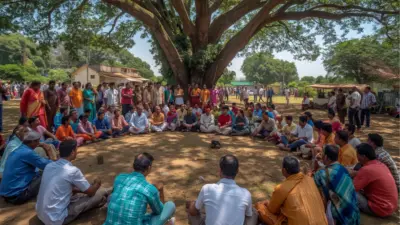

The northeastern states have emerged as some of India's strongest performers in grassroots democracy, recording among the highest levels of public awareness and citizen participation in Gram Sabha meetings, according to the National Institute of Rural Development and Panchayati Raj's (NIRDPR) Low Participation in Gram Sabha State-wise Reports 2026. While the region continues to battle geographical isolation, poor connectivity and livelihood-related constraints, its village assemblies are proving to be among the country's most inclusive forums for local governance.
The report suggests that the Northeast presents a striking contrast with several larger states, where social barriers, political interference, low public trust and weak institutional responsiveness continue to undermine Gram Sabha participation despite better infrastructure.
Assam and Arunachal Pradesh emerge as standout performers in the region. Assam recorded one of the highest awareness levels nationally, with 99.17 per cent of respondents aware of Gram Sabha meetings, 96.67 per cent aware of their rights and 91.67 per cent reporting active participation. Women, Scheduled Castes, Scheduled Tribes and Self-Help Group (SHG) members were identified as among the most active participants, while nearly every respondent acknowledged active participation by women and tribal communities. Unlike many other states, participation by line department officials was also reported to be exceptionally high, indicating stronger administrative engagement with Panchayats.
Arunachal Pradesh presents an equally encouraging picture. The survey found almost universal awareness of Gram Sabha meetings, strong tribal participation and widespread involvement of women and youth in village deliberations. However, the state's mountainous terrain makes conducting Gram Sabha meetings significantly more expensive than elsewhere in the country. Most respondents reported expenditure exceeding ₹5,000 per meeting, with many estimating costs between ₹10,000 and ₹25,000 because of logistics, transportation and basic infrastructure requirements. Rather than social exclusion, respondents identified geography, difficult accessibility and livelihood commitments as the principal barriers to participation.
Across the Northeast, the report identifies a recurring pattern: participation is generally high, but practical challenges remain. Migrant workers, youth and elderly citizens continue to be underrepresented, while work commitments, agricultural activities and long travel distances frequently prevent villagers from attending meetings. Respondents also called for greater transparency, quicker implementation of Gram Sabha decisions and better communication so that every household receives advance information about meetings.
The findings assume greater significance when viewed against the experience of several larger states.
In Bihar, for instance, awareness of Gram Sabha meetings is almost equally high at 98.8 per cent and awareness of quorum provisions is an impressive 94.4 per cent-far above Assam's 38.3 per cent. Yet respondents reported that caste divisions, gender barriers, political interference, corruption concerns and lack of trust in decision-making continue to discourage participation in several Panchayats. Delays in implementing Gram Sabha decisions and concerns over transparency were also widely reported despite strong procedural awareness.
Chhattisgarh similarly records very high awareness (98.8 per cent) and active participation (90.76 per cent), backed by one of the country's strongest digital infrastructures for Gram Sabhas, including widespread availability of internet connectivity, digitised records and video conferencing facilities. However, respondents reported that many meetings are perceived as mere formalities, with concerns over favouritism in beneficiary selection, corruption, lack of transparency and inadequate follow-up on decisions reducing public confidence. Even with high awareness, quorum is often not achieved, pointing to the difference between awareness and actual participation.
The contrast highlights an important trend. While several larger states possess better physical and digital infrastructure, northeastern states appear to derive greater strength from social cohesion, active participation by tribal communities and stronger engagement of women and community institutions.
Another distinguishing feature of the Northeast is the centrality of local development issues in Gram Sabha deliberations. In Assam, discussions revolve around identifying local problems, beneficiary selection, health, literacy, welfare schemes, livelihoods and infrastructure rather than procedural matters alone. The report notes that Gram Sabhas continue to function as genuine platforms for village-level planning and community problem-solving.
The report also underscores the remarkable role played by women in the region's grassroots governance. In Assam, almost every respondent reported active participation by women and Scheduled Tribe communities. Arunachal Pradesh similarly recorded high levels of participation among women and tribal citizens, reinforcing the Northeast's reputation for relatively inclusive local governance compared with several parts of the country where women still struggle to influence deliberations despite constitutional reservations.
Dear Reader,
Every day, our team at EastMojo travels through rain, rough roads, and remote hills to bring you stories that matter - stories from your town, your people, your Northeast.
We do this because we believe in truthful, independent journalism. No big corporate backing, no government pressure - just honest reporting by local journalists who live and breathe the same air you do.
But to keep doing this work, we need you. Your small contribution helps us pay our reporters fairly, reach places others ignore, and keep asking the tough questions.
If you believe the Northeast deserves its own fearless voice, stand with us.
Support independent journalism. Be a Member.
Thank you,
Karma Paljor
Editor-in-Chief, eastmojo.com

New ginger lily named after Zubeen Garg
Dear Sikkim, 'Teesta Matters to me' is not just another slogan
Explainer: The hidden risks confronting women journalists in Northeast India

Assam: Rare plant rediscovered after 180 years
How torrential rain in Nagaland devastated Upper Assam

How Subi Taba's stories made me see my village differently
How a small Kabui village set a benchmark in environment conservation
My daughter, my city, and a protest a thousand miles from Jantar Mantar
Digital adoption is another area where the region is making steady progress. Assam reported widespread use of WhatsApp and social media for disseminating Gram Sabha information, alongside internet connectivity in many Panchayats. However, respondents pointed to shortages of sound systems, digitised records, audio-visual equipment and adequate meeting spaces, indicating that investment in governance infrastructure has not kept pace with growing citizen participation.
The study concludes that the Northeast offers valuable lessons for the rest of the country. Despite difficult terrain, dispersed settlements and limited financial resources, the region has succeeded in creating highly participatory village institutions driven by community ownership, women's involvement and tribal representation. Addressing persistent challenges such as transportation, infrastructure deficits, livelihood constraints and timely implementation of Gram Sabha decisions could transform the region into a national model for participatory local governance.