
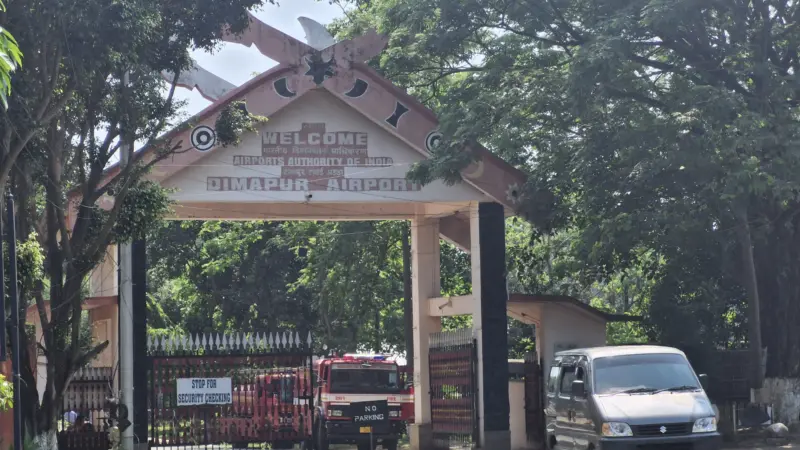

More than a decade after plans were first drawn up to expand Dimapur Airport, Nagaland's only commercial airport remains constrained by a problem that is neither technical nor financial, but institutional.
At the heart of the delay lies a continuing standoff between civilian infrastructure authorities and a central security force operating under the Ministry of Home Affairs (MHA).
This week, the Dimapur Urban Council Chairmen Federation (DUCCF), publicly accused the Assam Rifles Training Centre (ARTC) of failing to fully vacate 18.9 acres of land required for the first phase of the airport's expansion. In a statement issued to the media, the federation urged the MHA to intervene decisively and issue clear directions to its force, warning that further delay was undermining public welfare and stalling a nationally significant infrastructure project.
DUCCF revealed that as per documented records, it is "clearly" established that the Dimapur Airfield was formally handed over by the Indian Air Force to the National Airports Authority (now Airports Authority of India) in the year 1987, along with all fixed assets and external services, on an "as-is-where-is" basis. The effective date of transfer was September 1, 1987, after which full authority, rights, and administrative control of the said land was vested with the civil aviation authorities.
"Despite this clear transfer of ownership and jurisdiction, the continued occupation of airport- acquired land by ARTC is untenable, unjustified, and contrary to public interest. Such occupation not only violates the spirit and intent of the original land acquisition but also impedes critical infrastructure development, airport expansion, and public utility projects vital for the growth and safety of Dimapur and Nagaland at large," the DUCCF said.
The 18.9 acres form the first phase of evacuation and are a crucial component of the airport's approved master plan for Phase I developmental works. It was recently reported that the ARTC was required to vacate the land by October 2025; however, the process was affected after the Ministry of Home Affairs (MHA), in a communication to the Ministry of Civil Aviation in September 2025, requested that 2.27 acres of the earmarked land be retained "for the time being."
The MHA reportedly cited the presence of an approach road to family accommodation, underground water supply infrastructure, and two transformers on the site. Following the MHA's communication, the Ministry of Civil Aviation apprised the AAI Dimapur Airport, after which a committee was constituted in December to examine the matter.
"In the interest of transparency, rule of law, and public welfare, DUCCF- Calls upon ARTC to immediately vacate the acquired airport land without further resistance; Appeals to the Ministry of Home Affairs (MHA), Government of India, to take a firm and decisive stand by issuing necessary directions to enforce the vacation of the premises and Urges the State Government and concerned authorities to uphold the sanctity of official records and ensure that public land meant for strategic infrastructure is not misused or unlawfully retained," the DUCCF said.
The land in question was identified years ago through joint examinations involving the Airport Authority of India (AAI), the Nagaland government and district administration, according to both DUCCF statements and earlier reporting by regional media in Nagaland. The expansion plan requires the land to improve runway safety areas and allied infrastructure-upgrades that aviation regulators have long flagged as necessary for safe operations and future traffic growth.
Dimapur Airport occupies an unusually sensitive urban location. It sits in Nagaland's largest city and commercial centre, while also bordering long-established Assam Rifles facilities. The arrangement dates back to a period when Dimapur was a small town and security considerations dominated land use planning. Over time, however, Dimapur has grown into a major urban and economic hub, while the airport has emerged as the state's primary link to the rest of India.
Yet, despite the city's transformation, institutional boundaries have remained largely frozen.
According to local authorities and AAI officials quoted in previous infrastructure review meetings, land availability-not funding or design-has been the principal bottleneck preventing the airport from being upgraded. Eviction drives around the airport perimeter have reclaimed encroached civilian land, but the most critical parcel for Phase I expansion remains only partially cleared, with the Assam Rifles continuing to occupy sections earmarked for handover.
The DUCCF's statement is notable not merely for its demand, but for where it places responsibility. By appealing directly to the Ministry of Home Affairs, the federation has effectively argued that the delay is no longer a matter of inter-agency coordination but of political will and administrative command.
The Assam Rifles functions under the MHA, not the state government. This means that once disagreements arise between a central force and civilian infrastructure agencies, state authorities have limited power to enforce timelines. In such cases, resolution depends almost entirely on intervention from the Union ministry.
This is not an isolated governance problem. Across India's border states and conflict-affected regions, civilian infrastructure projects-airports, highways, rail corridors-have frequently run into delays when security establishments retain control over strategically located land, even after those locations lose their original operational relevance. What distinguishes the Dimapur case is the scale of impact: the land dispute affects the only airport in an entire state.
The consequences of this delay are not abstract. Dimapur Airport operates with limited runway margins and constrained apron space, restricting aircraft type, frequency and safety buffers. Aviation planners have repeatedly pointed out that without expansion, the airport cannot accommodate future traffic growth or meet evolving safety standards. For Nagaland, this translates into higher travel costs, reduced tourism potential, weaker emergency connectivity and a continued dependence on neighbouring states for access.
The DUCCF acknowledged the importance of national security considerations but argued that these cannot become a veto over civilian development indefinitely. It called for alternative arrangements for ARTC facilities to be expedited, rather than allowing unresolved internal concerns to paralyse a public infrastructure project of regional and national importance.
So far, neither the Assam Rifles nor the MHA has issued a public response to the federation's appeal. This silence has sharpened local criticism, particularly because the land requirement-18.9 acres-has already been formally assessed and approved through established government processes. From the perspective of local bodies, the issue is no longer about evaluation, but about execution.
In June last year, in connection to the Dimapur Airport land encroachment case, Nagaland Police have named 31 accused-25 private individuals and six public servants-for allegedly illegally occupying government land using forged documents. 24 illegal structures at the airport were also demolished.
For policymakers in New Delhi, the Dimapur Airport impasse raises a larger question about civilian oversight of security land holdings in rapidly urbanising regions. As the Union government pushes connectivity-driven development across the Northeast, unresolved institutional overlaps threaten to undermine those goals.
Dear Reader,
Every day, our team at EastMojo travels through rain, rough roads, and remote hills to bring you stories that matter - stories from your town, your people, your Northeast.
We do this because we believe in truthful, independent journalism. No big corporate backing, no government pressure - just honest reporting by local journalists who live and breathe the same air you do.
But to keep doing this work, we need you. Your small contribution helps us pay our reporters fairly, reach places others ignore, and keep asking the tough questions.
If you believe the Northeast deserves its own fearless voice, stand with us.
Support independent journalism. Be a Member.
Thank you,
Karma Paljor
Editor-in-Chief, eastmojo.com

Science confirms what locals knew: Leaves are a healthy alternative to plastic wraps

Mimi village's dying art: Reviving Nagaland's hand pottery tradition
Silence of the Wah Umkhrah: What Khasi myths teach us about loss and belonging

NDPP-NPF merger impacts Manipur and Arunachal Nagas too: Here's how

What the NDPP-NPF merger means for Nagas and the rest of Northeast

How Tripura CM's remark on Reang migration stirred a political storm

Himachal's united effort tracks elusive Snow Leopards in record time

How indigenous knowledge helped experts detect Pangolins in Arunachal
Dimapur Airport is often described locally as Nagaland's "gateway to the world." Its prolonged stagnation now stands as a test case of whether national infrastructure priorities can prevail over bureaucratic inertia within the security establishment-or whether strategic caution will continue to outweigh civilian necessity by default.
The DUCCF has made its position clear. What remains uncertain is whether the Ministry of Home Affairs is willing to enforce its own chain of command in the interest of public infrastructure and regional development.
Also Read | Nagaland records GST growth at 37% despite rate cuts