




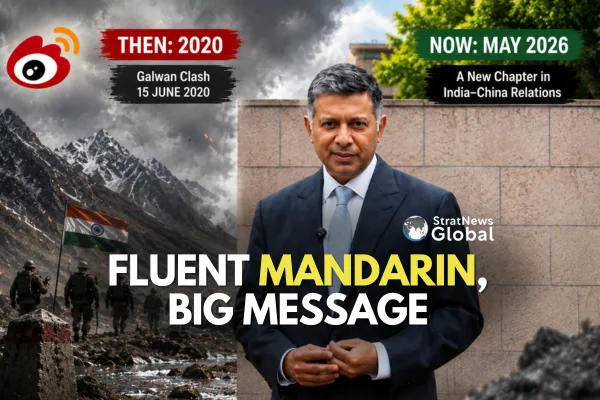

Six years ago, at the height of India-China tensions, Prime Minister Narendra Modi's Weibo account disappeared from Weibo, China's largest social media platform.
Today, an Indian diplomat is attracting attention on that very same platform by speaking fluent Mandarin to Chinese audiences. The outreach has also appeared on Douyin, the Chinese version of TikTok.
As the anniversary of the Galwan clash approaches on 15 June, India's Ambassador to China, Vikram Doraiswami, who took up his post in Beijing earlier this month, is drawing attention on Chinese social media for a very different reason: addressing Chinese audiences directly in their own language.
This morning, the official Weibo account of the Indian Embassy in Beijing (印度驻华大使馆), which has more than 183,000 followers, released a video featuring Doraiswami speaking entirely in Mandarin. In the video, he explains the history of the Indian Embassy in China, when it was established, and the services it provides to both Indian and Chinese citizens.
While the video itself is largely informational, its timing is noteworthy. As India and China cautiously rebuild ties after years of tensions, Doraiswami's decision to address Chinese viewers in their own language carries symbolic weight.
Rather than relying on translators or official statements, the ambassador presented India in fluent Mandarin, offering Chinese audiences a rare glimpse of Indian diplomacy in a language they use every day.
In an era when social media has become both an information hub and a battleground for competing narratives, such outreach carries significance beyond the digital sphere.
Following the deadly Galwan clash in June 2020, relations between New Delhi and Beijing deteriorated sharply. India subsequently banned dozens of Chinese applications, including TikTok and WeChat, amid growing concerns over security and sovereignty.
Shortly afterwards, Modi's Weibo account was removed at the request of the Indian Embassy in Beijing. The account had been created in 2015 as part of an effort to engage directly with Chinese citizens. His first post, written in Chinese, read: 'Hello China! Looking forward to interacting with Chinese friends through Weibo.'
At the time, the account's removal reflected the depth of the diplomatic freeze between the two Asian powers.
Six years later, India appears to be pursuing a different form of digital diplomacy. The embassy's growing online presence, combined with a Mandarin-speaking ambassador engaging directly with Chinese audiences, suggests a shift towards public outreach, accessibility and cultural engagement.